E-64 from Selleck Irreversibly Inhibits Cysteine Proteases via Active Site Alkylation
Copy code to add this image to your page
Cysteine proteases of the papain superfamily play critical catalytic roles in endolysosomal protein turnover, antigen processing, extracellular matrix remodeling, and programmed cell death. Dysregulated activity of these hydrolases—specifically cathepsins B, H, and L, alongside calcium-dependent calpains—is widely implicated in inflammatory joint diseases, malignant invasion, and neuromuscular degeneration. Pharmacological dissection of these proteolytic cascades necessitates small-molecule tools capable of achieving absolute target selectivity without cross-inhibiting distinct mechanistic protease classes. The natural product E-64, originally isolated from Aspergillus japonicus, serves as a primary reference inhibitor for establishing cysteine protease dependence across diverse biological systems.
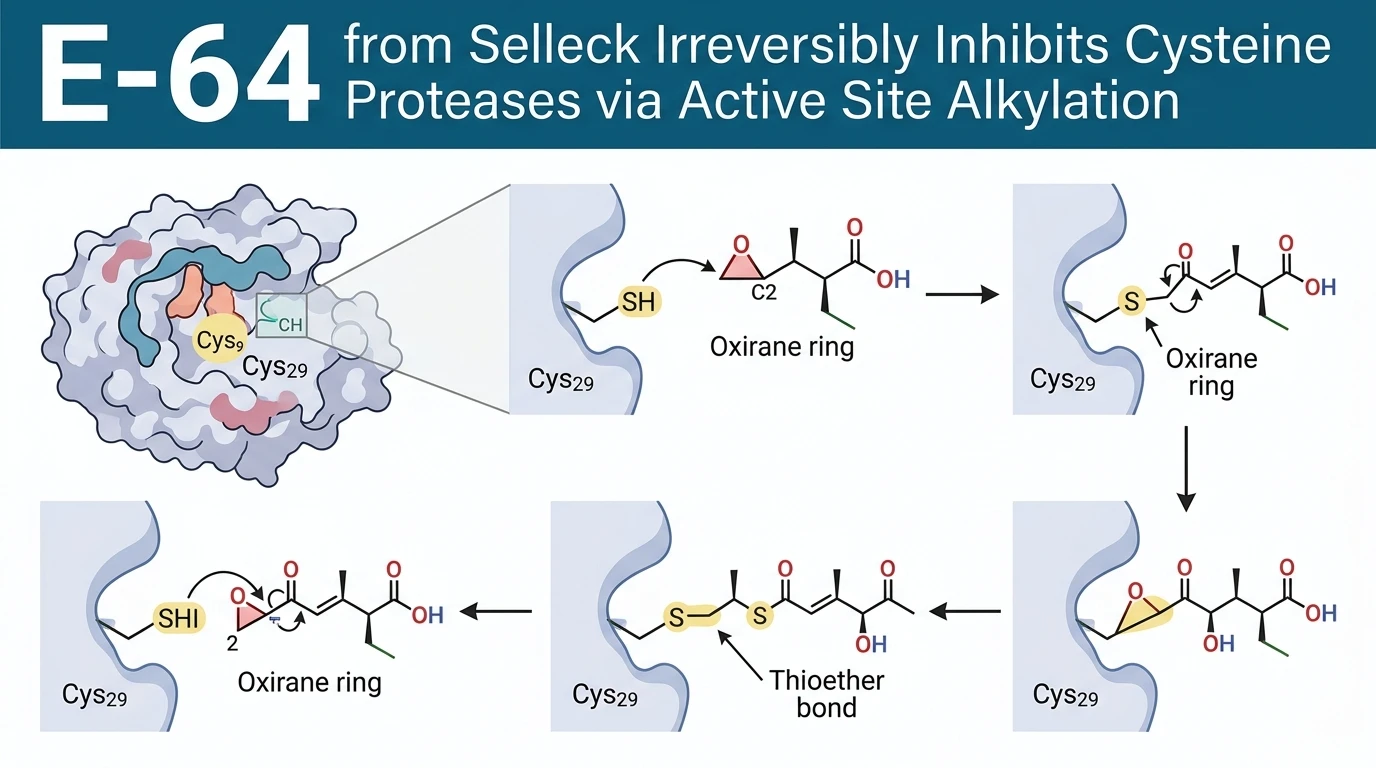
Chemically characterized as an epoxysuccinyl peptide derivative, L-trans-epoxysuccinyl-leucylamido(4-guanidino)butane (E-64) exerts its inhibitory effect through an irreversible, active-site-directed alkylation mechanism. The structural architecture of the molecule features an electrophilic oxirane ring designed to fit into the S2-S1' sub-sites of papain-like enzymes. Upon binding, the catalytic nucleophile—a strictly conserved cysteine thiol (e.g., Cys25 in papain, Cys29 in Cathepsin B)—attacks the C2 carbon of the epoxysuccinyl moiety. This nucleophilic ring-opening reaction forms a stable, covalent thioether adduct. Because this modification destroys the nucleophilic capacity of the active-site triad, enzyme restoration requires de novo protein synthesis. In biochemical kinetic studies, E-64 displays exceptionally high second-order inactivation constants (k_inact/K_i) toward cathepsin B and cathepsin L, driving rapid, complete target occupancy at low micromolar to nanomolar concentrations under standard assay parameters.
A fundamental feature of E-64 from Selleck is its complete selectivity for cysteine proteases over other mechanistic classes. Serine proteases (such as trypsin, chymotrypsin, and elastase), aspartic proteases (such as pepsin and renin), and metalloproteases (including matrix metalloproteinases) remain completely uninhibited even when exposed to millimolar concentrations of the compound. This absolute class selectivity arises from the distinct nucleophilic requirements of the active site; neither serine hydroxyl groups nor water molecules coordinated by catalytic zinc ions possess sufficient reactivity to open the epoxysuccinyl ring under physiological conditions. Consequently, E-64 from Selleck provides an unambiguous diagnostic readout when identifying the precise proteolytic machinery responsible for substrate degradation in complex cell lysates.
In cell biology research, E-64 is routinely deployed to inhibit intracellular proteolysis within lysosomal compartments and cytosol. While the charged guanidino group limits passive membrane permeability in short-term assays, extended incubation periods or cell permeabilization protocols permit complete inhibition of intracellular cathepsin activity. Researchers utilize E-64 to arrest lysosomal degradation, enabling the accumulation and subsequent identification of transient autophagic substrates, endocytosed receptors, and pathologic protein aggregates. In cell-free systems and purified enzyme preparations, E-64 serves as an indispensable active-site titrant to determine exact molar concentrations of functional cysteine proteases. Through its absolute catalytic selectivity and irreversible engagement, E-64 remains a standard probe for validating cysteine proteases as functional targets in human disease models.
Pharmacological Profiling and Covalent Active Site Engagement
Copy code to add this image to your page
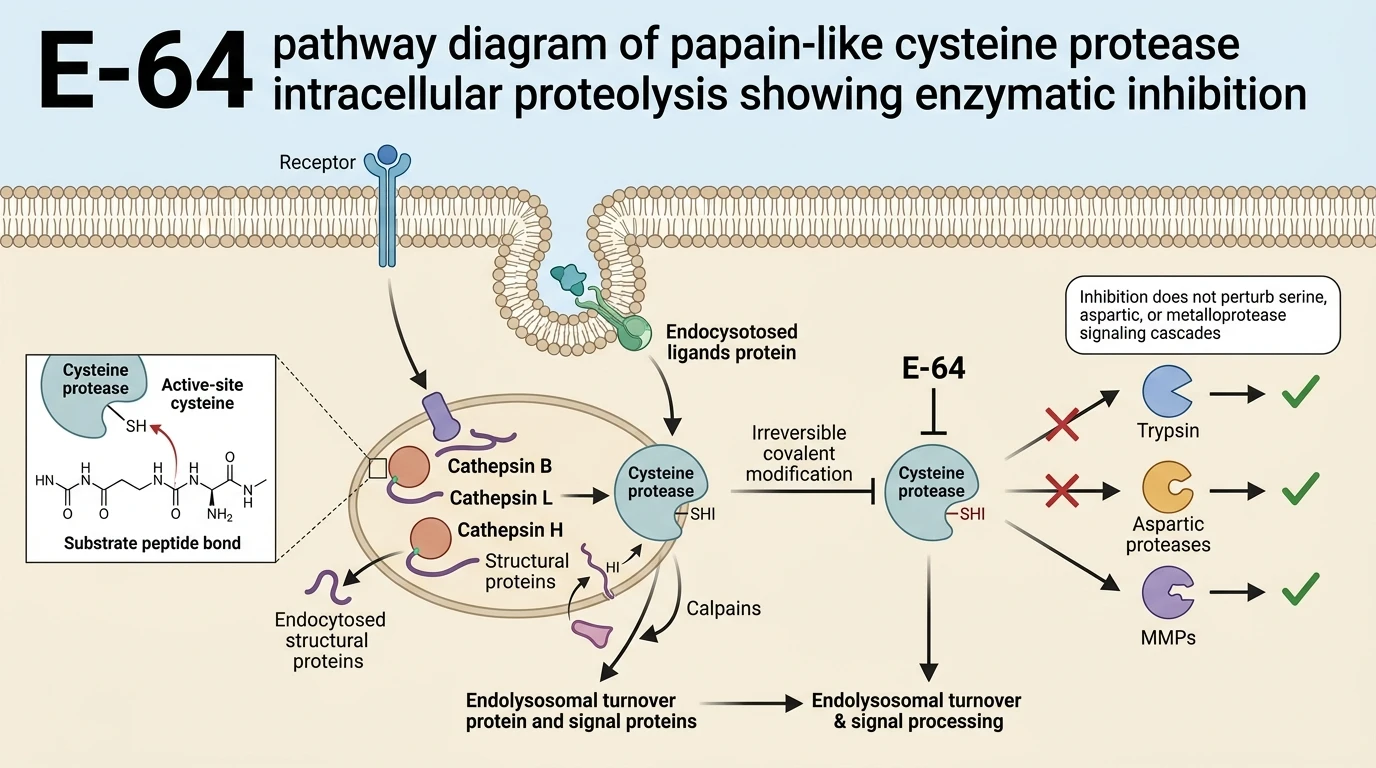
E-64 functions as an irreversible inhibitor of cysteine proteases by forming a covalent adduct with the active-site catalytic thiol group. Isolated from Aspergillus japonicus, its epoxysuccinyl core selectively targets papain family enzymes—including cathepsins B, H, L, and calpains—without cross-reacting with serine, aspartic, or metalloproteases under physiological assay conditions.
Covalent Epoxysuccinyl Alkylation Selectively Blocks Catalytic Thiols
E-64 targets the nucleophilic cysteine residue situated within the catalytic triad of papain-like proteases. The electrophilic oxirane ring undergoes irreversible ring-opening upon nucleophilic attack by the active-site thiol group. Enzymatic activity drops rapidly following inhibitor exposure. This covalent modification permanently inactivates the catalytic domain. Under in vitro assay conditions, E-64 from Selleck exhibits nanomolar potency against purified cathepsin B and cathepsin L. The covalent adduct remains completely stable across broad pH ranges. Unlike reversible competitive agents, inhibition persists even after extensive dialytic washout. This irreversible mechanism ensures complete target suppression during kinetic degradation experiments.
Exclusion of Non-Cysteine Protease Families in Assays
Class selectivity remains an essential requirement for functional protease profiling in complex biological samples. E-64 from Selleck demonstrates absolute specificity for cysteine hydrolases without cross-reacting with alternate catalytic mechanisms. Serine proteases retain full hydrolytic capacity in the presence of millimolar inhibitor concentrations. Metalloproteinase activity remains similarly unperturbed during co-incubation assays. Aspartic proteases like cathepsin D show zero sensitivity to epoxysuccinyl alkylation. The structural configuration of the epoxysuccinyl core prevents off-target interactions with serine hydroxyl nucleophiles. This extreme selectivity allows precise attribution of proteolytic events to cysteine hydrolase pathways.
Suppression of Lysosomal Protein Degradation in Vitro
Application of the inhibitor in cellular models impairs endolysosomal protein turnover. Substrate cleavage within isolated lysosomal fractions ceases rapidly upon compound treatment. Autophagic flux assays reveal clear substrate accumulation following cathepsin blockage. Cellular viability remains intact across standard experimental windows. In murine organotypic slices, E-64 from Selleck prevents pathological protein cleavage without inducing acute cytotoxic responses. The resulting substrate stabilization provides direct evidence of specific cysteine protease participation. These empirical observations establish the compound as a standard reference agent for cellular proteolysis assays.