Plerixafor (AMD3100) 8HCl targets CXCR4 to overcome stromal resistance in leukemia
Copy code to add this image to your page
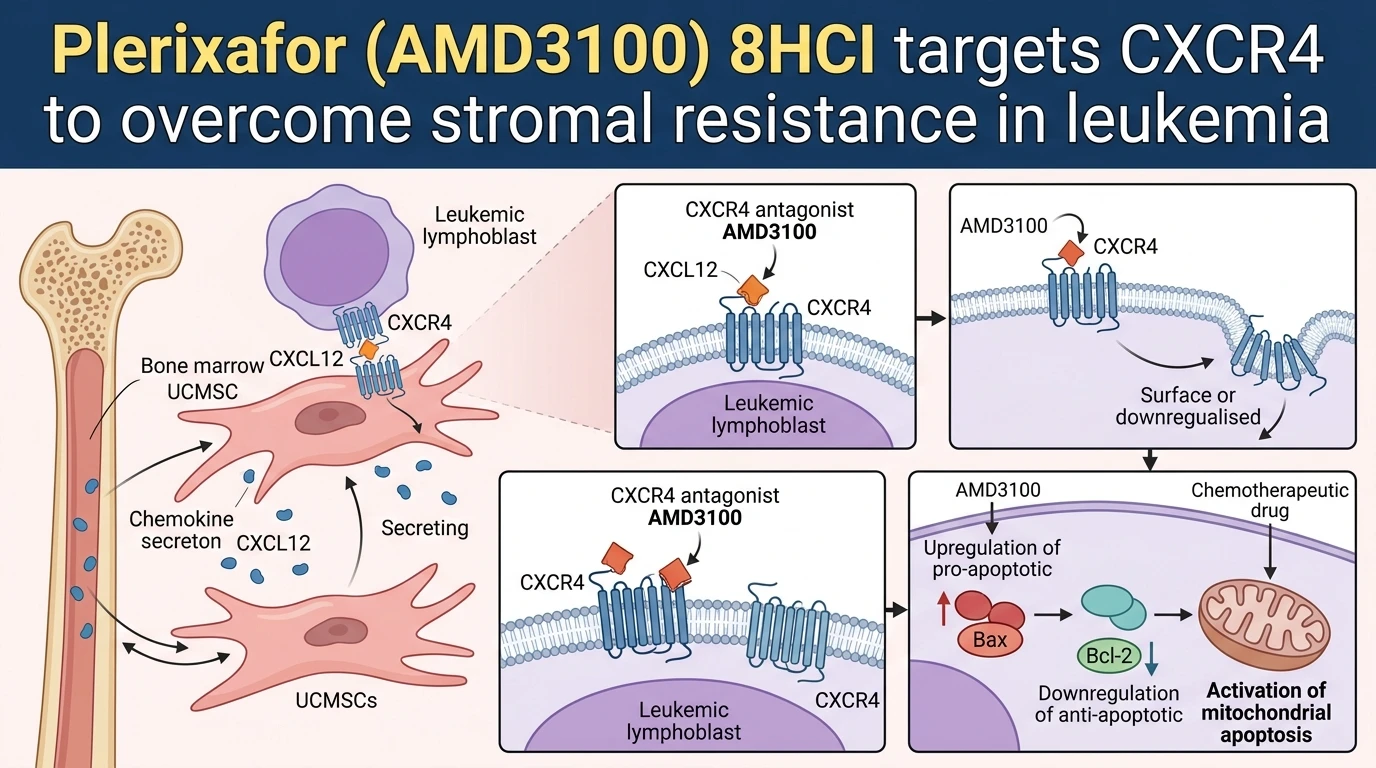
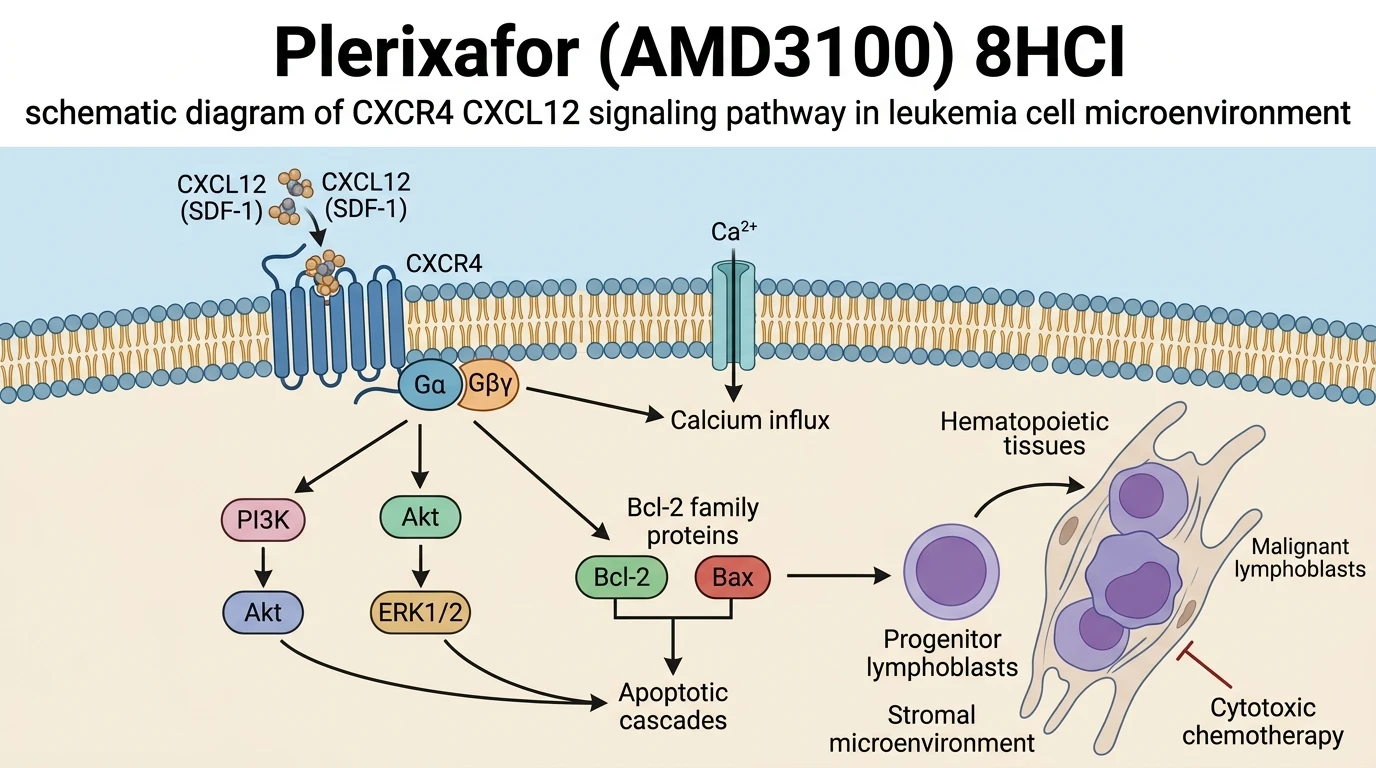
Overexpression of CXCR4 (CXC chemokine receptor-4) represents a hallmark of primary refractory and relapsed acute lymphoblastic leukemia (R/R ALL). Quantitative expression analysis reveals significantly elevated surface density of CXCR4 in primary blast cells isolated from R/R ALL patients compared to newly diagnosed patient cohorts. This receptor elevation correlates with enhanced homing capacity toward bone marrow and umbilical cord mesenchymal stem cell (UCMSC) niches. Within these protective microenvironments, stromal cells constitutively secrete CXCL12, establishing a chemical gradient that sequesters leukemic lymphoblasts. The resulting physical interaction between UCMSCs and leukemic blasts confers pronounced chemoresistance against standard antineoplastic agents, including vincristine (VCR).
In vitro co-culture assays involving primary R/R ALL lymphoblasts and UCMSCs demonstrate a profound suppression of drug-induced apoptosis. Exposure of isolated ALL blasts to therapeutic concentrations of VCR induces robust apoptosis via classical mitochondrial outer membrane permeabilization. However, co-culturing these cells with UCMSC monolayers markedly diminishes VCR-mediated cell death. Western blot and qPCR evaluations confirm that UCMSC contact alters the internal balance of Bcl-2 family proteins within leukemic blasts. Specifically, stromal engagement downregulates pro-apoptotic Bax expression while simultaneously upregulating anti-apoptotic Bcl-2. This altered Bax/Bcl-2 stoichiometry elevates the apoptotic threshold, allowing leukemic cells to evade cytotoxic stress under co-culture conditions.
Pharmacological intervention with Plerixafor (AMD3100) 8HCl disrupts this microenvironmental protective axis. As a selective CXCR4 antagonist, AMD3100 competitively inhibits CXCL12 binding to CXCR4. Exposure to Plerixafor (AMD3100) 8HCl leads to target occupancy, resulting in the downregulation of surface CXCR4 density on leukemic blasts alongside a measurable reduction in secreted CXCL12 levels within the local co-culture supernatant. Disruption of this receptor-ligand interaction mobilizes leukemic cells away from UCMSC feeder layers, effectively stripping blasts of stromal survival cues.
Reversal of UCMSC-mediated chemoresistance relies on restoring pro-apoptotic transcriptional programs. Co-treatment of resistant R/R ALL cells with AMD3100 and VCR abrogates the protective effect of UCMSCs. Mechanistically, CXCR4 inhibition by Plerixafor (AMD3100) 8HCl restores Bax expression levels in a dose-dependent manner while reducing intracellular Bcl-2 levels back to baseline ratios. The upregulation of Bax re-establishes mitochondrial sensitivity to VCR, facilitating cytochrome c release and subsequent caspase-3 cleavage. Consequently, combination treatment significantly increases apoptotic rates in R/R ALL lymphoblasts relative to VCR monotherapy in stromal co-cultures.
Evaluating mitochondrial membrane potential (Δ̸m) confirms that UCMSC protection preserves mitochondrial integrity during VCR exposure. In isolated ALL cultures, VCR causes rapid loss of Δ̸m within 24 hours. Under UCMSC co-culture, Δ̸m remains largely stable due to elevated Bcl-2 activity. Application of Plerixafor (AMD3100) 8HCl rapidly reverses this protective phenotype. Within 12 hours of exposure at low micromolar concentrations, AMD3100 destabilizes the mitochondrial membrane in co-cultured lymphoblasts exposed to VCR.
Flow cytometric analysis of annexin V and propidium iodide staining demonstrates a three-fold increase in early and late apoptotic populations when AMD3100 is combined with VCR, compared to VCR treatment alone in the presence of UCMSCs. Furthermore, enzyme-linked immunosorbent assay (ELISA) quantification indicates a marked decline in soluble CXCL12 concentrations in co-culture media following treatment. Primary blast samples derived from bone marrow aspirates of R/R ALL patients exhibit variable baseline CXCR4 expression levels; notably, blasts expressing higher receptor densities display greater sensitivity to AMD3100-mediated chemosensitization. Thus, blocking CXCR4 disruptively rewires apoptotic pathway signaling within the leukemic stem cell niche.
Pharmacological Reversal of Microenvironmental Chemoresistance
Copy code to add this image to your page
Plerixafor (AMD3100) 8HCl functions as a selective antagonist of CXCR4, disrupting the protective CXCR4/CXCL12 signaling axis between acute lymphoblastic leukemia cells and umbilical cord mesenchymal stem cells. By inhibiting ligand binding, the compound decreases surface CXCR4 density and lowers soluble CXCL12 levels in the microenvironment. This blockade downregulates anti-apoptotic Bcl-2 while upregulating pro-apoptotic Bax, overriding stromal-mediated resistance and sensitizing relapsed/refractory leukemic blasts to vincristine-induced apoptosis.
UCMSC Co-Culture Suppresses Chemotherapy-Induced Leukemic Apoptosis
Stromal microenvironments confer profound survival advantages to acute lymphoblastic leukemia cells. In patient-derived cell models, co-culturing primary blasts with UCMSCs reduces vincristine-induced apoptosis by nearly 60 percent under tested in vitro assay conditions. This anti-apoptotic effect depends upon direct cell-to-cell contact and paracrine CXCL12 secretion. Stromal protection correlates with a significant alteration in mitochondrial regulatory proteins. Specifically, pro-apoptotic Bax expression drops sharply upon stromal contact, while anti-apoptotic Bcl-2 levels rise. This molecular balance shields leukemic lymphoblasts from cytotoxic insult. Consequently, standard chemotherapeutic dosing fails to eliminate niche-bound malignant populations.
CXCR4 Antagonism Restores Bax Expression and Sensitizes Blasts
Targeted blockade of surface receptors can disrupt microenvironmental protective networks. Treatment with AMD3100 blocks CXCL12 binding and decreases surface receptor availability. Within this specific cellular context, CXCR4 blockade suppresses downstream survival signaling cascades. Short exposure to the antagonist restores intracellular Bax expression within 24 hours. Simultaneously, baseline Bcl-2 accumulation diminishes across treated lymphoblast populations. Re-establishing high Bax-to-Bcl-2 ratios reactivates downstream caspase cascades upon vincristine administration. The restored apoptotic response restores chemotherapeutic efficacy in previously resistant cell fractions.
Reduction of Secreted CXCL12 Attenuates Stromal Retention Signals
Paracrine signaling within the leukemic niche depends upon stable chemokine gradients. In stromal co-culture assays, application of AMD3100 leads to a quantifiable reduction in soluble CXCL12 concentrations in media supernatants. Receptor engagement appears to disrupt autocrine and paracrine feedback loops maintaining ligand expression. Lower CXCL12 levels weaken the retention forces anchoring blast cells to feeder layers. Detached lymphoblasts lose essential stromal survival signals. Preliminary observations suggest that this displacement renders refractory lymphoblasts significantly more sensitive to systemic chemotherapeutic agents.