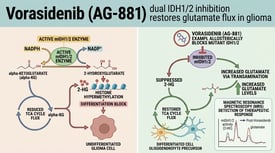
Isocitrate Dehydrogenase (IDH) Inhibitors
Isocitrate dehydrogenases (IDHs) are a family of enzymes crucial for cellular metabolism, catalyzing the oxidative decarboxylation of isocitrate to α-ketoglutarate (α-KG) within the Krebs cycle. This reaction produces NADPH, a vital cofactor for antioxidant defense and anabolic processes. In humans, three isoforms exist: IDH1 (cytosolic), IDH2 (mitochondrial), and IDH3 (mitochondrial, NAD+-dependent). Oncogenic mutations in IDH1 (most commonly R132H) and IDH2 (most commonly R172K or R140Q) are found in various cancers. These mutations confer a neomorphic enzyme activity, causing the mutant IDH to convert α-KG into the oncometabolite 2-hydroxyglutarate (2-HG). Elevated levels of 2-HG act as a competitive inhibitor of numerous α-KG-dependent dioxygenases, including histone demethylases and TET DNA demethylases.
This inhibition leads to widespread epigenetic dysregulation, including altered histone methylation and DNA hypermethylation, which collectively block cellular differentiation and promote oncogenesis. Diseases associated with IDH mutations primarily include acute myeloid leukemia (AML), gliomas (astrocytomas and oligodendrogliomas), chondrosarcoma, and cholangiocarcinoma. The presence of these mutations defines distinct disease subsets with specific clinical characteristics and prognoses. The discovery of mutant IDH's role in cancer has led to a highly successful targeted therapy approach. Ivosidenib (Tibsovo), a selective inhibitor of mutant IDH1, is approved for IDH1-mutated AML and cholangiocarcinoma. Enasidenib (Idhifa), a selective inhibitor of mutant IDH2, is approved for IDH2-mutated AML.
These drugs work by reducing 2-HG levels, which allows for the re-establishment of normal epigenetic regulation and promotes the differentiation of cancer cells, a concept often referred to as 'differentiation therapy.' Vorasidenib, a dual IDH1/2 inhibitor, is in advanced clinical trials for IDH-mutated gliomas, showing promising results. IDH inhibitors are typically allosteric, binding to a site distinct from the active site, which allows for selective inhibition of the mutant enzyme while sparing the wild-type IDH. A key aspect of IDH inhibitor therapy is the requirement for biomarker testing to identify patients with specific IDH mutations. Challenges include potential resistance mechanisms, such as secondary IDH mutations or activation of bypass pathways. Combination therapies, often with conventional chemotherapy or other targeted agents, are being explored to enhance efficacy and overcome resistance. The success of IDH inhibitors exemplifies precision medicine, transforming the treatment landscape for patients with IDH-mutated cancers.