AMD3100 (Plerixafor) CXCR antagonist Suppresses CXCR4-Mediated Pulmonary Fibrosis and Inflammation
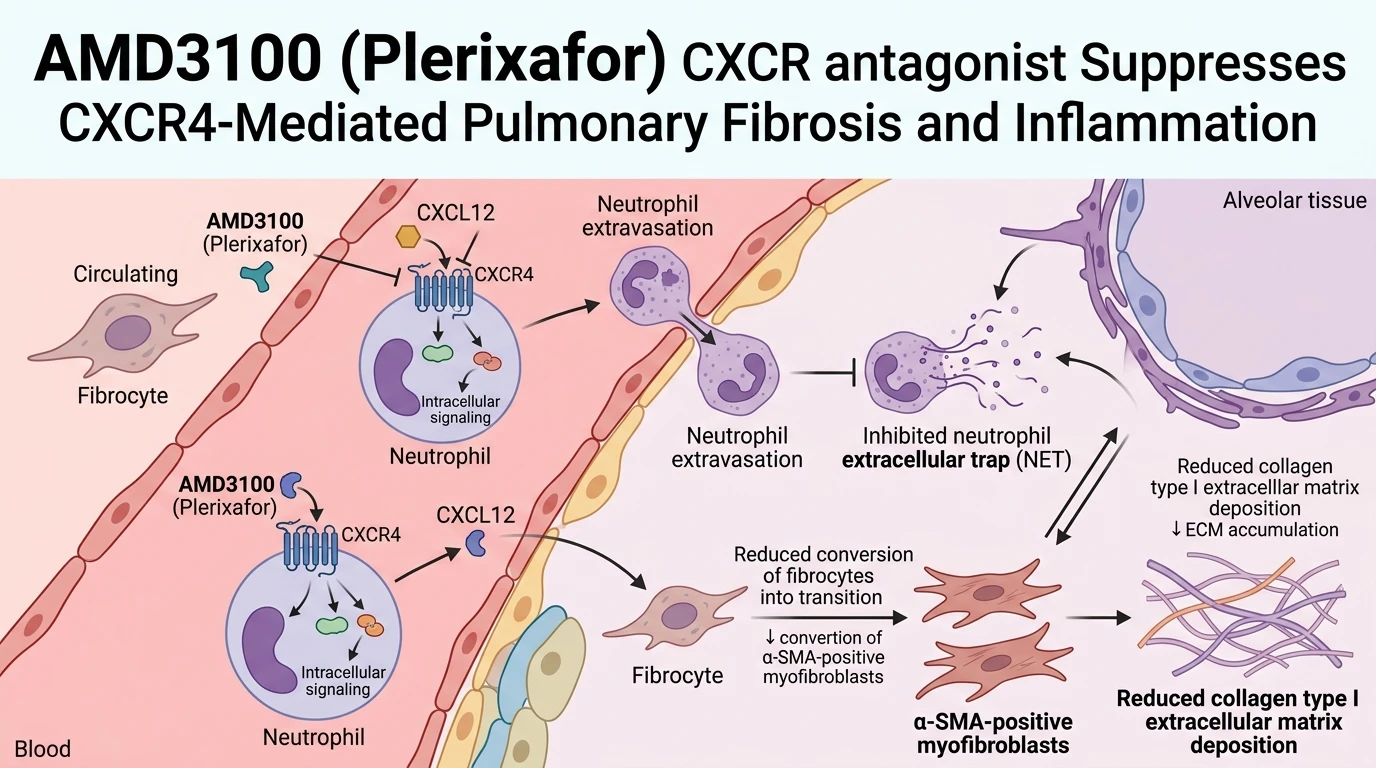
Copy code to add this image to your page
Inhalation of crystalline silica particles causes silicosis, an irreversible occupational lung disease characterized by sustained alveolar inflammation and progressive interstitial fibrosis. Pathologically, toxic silica particles damage alveolar macrophages and epithelial cells, triggering prolonged inflammatory signaling networks. A central axis in this pathobiology is the chemokine receptor CXCR4 and its primary ligand CXCL12 (stromal cell-derived factor-1, SDF-1). Following exposure to silica, local tissue expression of both CXCL12 and CXCR4 rises substantially within injured pulmonary tissue. This upregulated axis serves as a primary chemoattractant gradient for multiple circulating progenitor and effector cell populations, including CD45+ Collagen I+ fibrocytes, neutrophils, and B lymphocytes.
At the molecular level, engagement of CXCR4 by CXCL12 triggers heterotrimeric G-protein subunit dissociation (Gi/o family), activating downstream phosphoinositide 3-kinase (PI3K)/AKT and mitogen-activated protein kinase (MAPK/ERK) cascades. These signaling events stimulate intracellular calcium flux, focal adhesion kinase activation, and rapid cytoskeletal reorganization essential for cell polarization and directional motility. The recruitment of circulating fibrocytes represents a major mechanism underlying persistent extracellular matrix accumulation. Fibrocytes express functional CXCR4 on their cell surface, facilitating their migration along CXCL12 gradients established at sites of active tissue injury. Upon entering the pulmonary parenchyma, these progenitor cells differentiate into activated α-smooth muscle actin (α-SMA)-expressing myofibroblasts. These cells synthesize large quantities of structural matrix proteins, predominantly collagen type I, leading to architectural distortion and compromised gas exchange.
In parallel with fibrocyte mobilization, the CXCL12/CXCR4 axis regulates the recruitment and activation of inflammatory granulocytes and lymphocytes. Infiltration of polymorphonuclear neutrophils into the alveolar walls and bronchoalveolar space represents a hallmark of silica toxicity. Recruited neutrophils undergo activation and form neutrophil extracellular traps (NETs)—web-like structures composed of chromatin, histones, and cytotoxic enzymes such as myeloperoxidase and neutrophil elastase. While NETs participate in host defense, their aberrant release during non-infectious silica injury induces alveolar epithelial cell death and exacerbates local tissue destruction. Concurrently, B-cell infiltration driven by CXCL12 gradients culminates in the organization of tertiary B-lymphoid aggregates within damaged parenchymal regions, maintaining chronic immune stimulation.
Targeting this pathway with the AMD3100 (Plerixafor) CXCR antagonist provides a therapeutic strategy to interrupt cellular recruitment cascades. AMD3100 (Plerixafor) is a small-molecule bicyclam derivative that competitively binds to the extracellular loops and transmembrane domain of CXCR4, sterically hindering CXCL12 binding and inhibiting downstream G-protein-coupled signaling cascades. Pharmacological blockade using AMD3100 (Plerixafor) CXCR antagonist disrupts the chemoattractant signaling required for fibrocyte and leukocyte migration from peripheral circulation into damaged pulmonary microenvironments.
In experimental murine models of crystalline silica exposure, therapeutic administration of AMD3100 (Plerixafor) significantly altered disease progression. Treatment with the compound suppressed CXCR4 activation, leading to a marked decrease in circulating fibrocyte migration to the lungs. Consequently, tissue levels of α-SMA and collagen type I were substantially lowered compared to untreated control animals subjected to silica challenge. Furthermore, AMD3100 administration diminished neutrophil extravasation into alveolar spaces and reduced local NET formation markers. The reduction in NET density correlated with attenuated lung injury scores and improved maintenance of body weight over the experimental timeline. Additionally, AMD3100 treatment disrupted the formation of B-lymphoid aggregates, pointing to a broader dampening of organized local inflammatory responses in the evaluated murine models.
Pharmacological Target Engagement and Fibrotic Attenuation
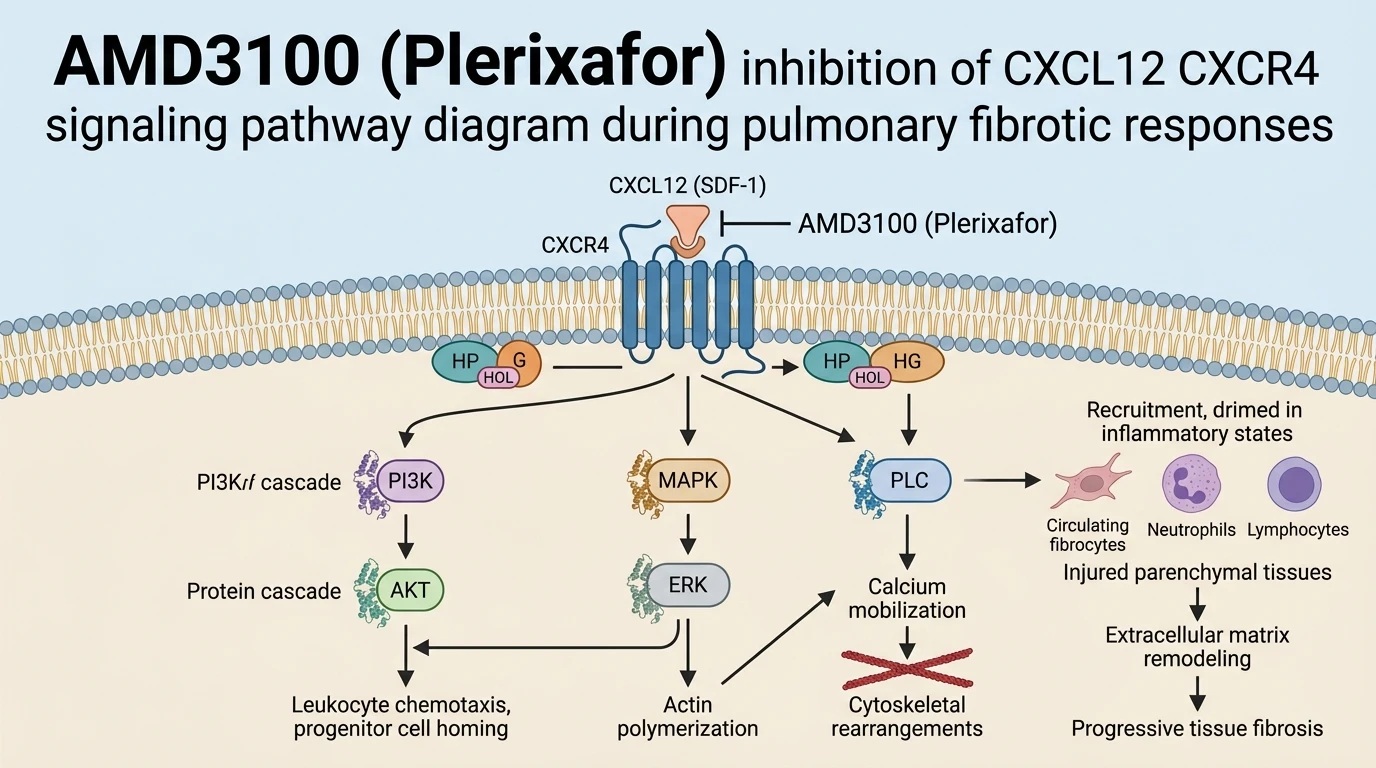
Copy code to add this image to your page
AMD3100 (Plerixafor) acts as a selective CXCR4 antagonist, blocking its interaction with CXCL12. In crystalline silica-induced pulmonary injury, silica exposure upregulates CXCL12/CXCR4 expression, driving the migration of CD45+/Collagen I+ fibrocytes, neutrophils, and B cells into lung tissues. By antagonizing CXCR4, AMD3100 inhibits leukocyte recruitment, suppresses neutrophil extracellular trap (NET) formation, reduces B-lymphoid aggregates, and prevents fibrocyte mobilization. This dual anti-inflammatory and anti-fibrotic action decreases collagen type I and α-smooth muscle actin deposition, preserving pulmonary architecture and mitigating silica-induced lung damage.
Inhibition of Neutrophil Extravasation and Extracellular Trap Formation
Infiltration of polymorphonuclear neutrophils into alveolar spaces represents an early pathological hallmark of silica toxicity. Cellular extravasation was reduced. Pharmacological intervention with the AMD3100 (Plerixafor) CXCR antagonist interrupted this inflammatory cascade within murine model systems. Extracellular trap formation decreased. Neutrophil extracellular traps release cytotoxic myeloperoxidase and histones into pulmonary spaces, whereas CXCR4 blockade limited these damaging exposures. Parenchymal neutrophil density dropped. Histological quantification verified a corresponding attenuation of alveolar wall thickening across treated tissue specimens. Neutrophil activity ceased driving acute destruction.
Suppression of Circulating Fibrocyte Migration and Matrix Deposition
Circulating fibrocytes migrate into damaged lung tissue along CXCL12 gradients. Directional cell motility ceased. Administration of AMD3100 (Plerixafor) CXCR antagonist disrupted fibrocyte chemotaxis in vitro and in vivo. Fibrocyte density within injured lung tissue dropped significantly. Lower fibrocyte infiltration correlated with reduced numbers of activated α-smooth muscle actin-positive myofibroblasts. Collagen deposition was evaluated. Expression of collagen type I decreased across analyzed pulmonary tissue sections. Hydroxyproline assays confirmed lower total pulmonary collagen accumulation in treated animal cohorts. Body weight loss stabilized following treatment.