SCR7 from Selleck Inhibits DNA Ligase IV to Enhance CRISPR HDR Efficiency
Copy code to add this image to your page
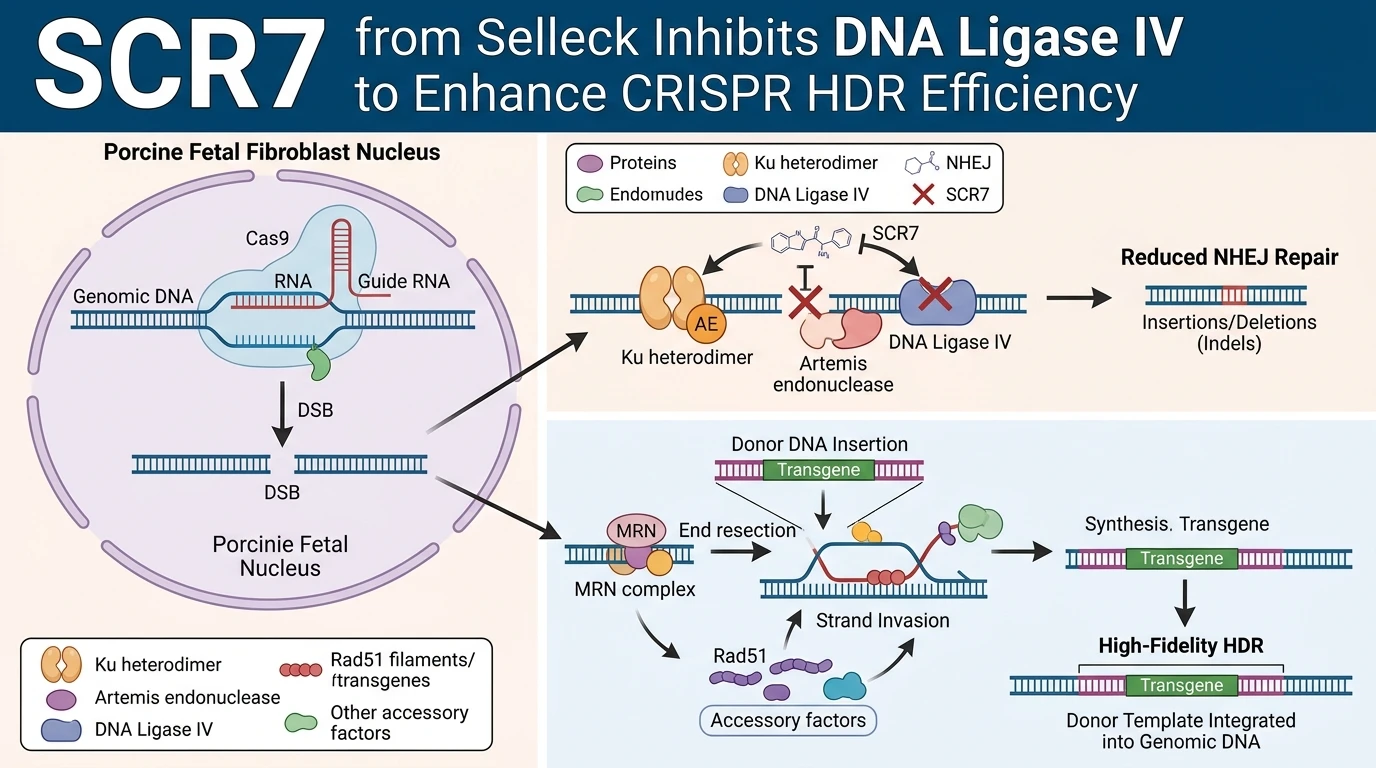
Precision genome editing using engineered nucleases, such as the CRISPR/Cas9 system, relies on cellular DNA damage response machinery to incorporate specific sequence alterations. Induced double-strand breaks (DSBs) are recognized by two competing primary repair pathways: non-homologous end joining (NHEJ) and homology-directed repair (HDR). Canonical NHEJ operates rapidly throughout all cell cycle phases, joining DNA ends in an error-prone manner that frequently introduces insertions or deletions (indels). Conversely, HDR provides error-free repair by utilizing homologous template DNA; however, its operational window is restricted to the S/G2 phases, resulting in lower baseline frequencies in mammalian cells. In primary somatic models, such as porcine fetal fibroblasts, the dominance of NHEJ presents a substantial barrier to achieving high-efficiency targeted gene integration.
Mechanistic intervention at key enzyme nodes within the NHEJ cascade offers a direct method to modulate pathway choice. DNA ligase IV (LIG4) functions as the essential catalytic enzyme in the final ligation step of canonical NHEJ, forming a tight complex with XRCC4 to seal phosphodiester backbone nicks. Small-molecule targeted inhibition of LIG4 using SCR7 disrupts this ligation cascade. By preventing competitive end-joining, the persistence of unrepaired DSBs extends the temporal window during which homologous recombination machinery can engage the break site with exogenous donor templates.
In primary porcine fetal fibroblast cultures, comparative pharmacological evaluation demonstrated that targeted pathway inhibition significantly skews DSB repair outcomes. Small-molecule intervention employing SCR7 from Selleck targeted the LIG4 enzyme interface, effectively suppressing default NHEJ activity. In eGFP reporter assays designed to quantify precise gene correction, LIG4 inhibition increased HDR conversion rates approximately two-fold compared to carrier-treated controls. Crucially, this transient catalytic blockade occurred without inducing significant cytotoxicity or altering baseline cell viability metrics under tested in vitro assay conditions.
When combined with CRISPR/Cas9 ribonucleoprotein delivery, small-molecule modulation facilitated large fragment genomic integration. Screening of isolated clonal colonies revealed targeted knock-in efficiencies exceeding 50% for multi-kilobase donor constructs, whereas untreated control populations exhibited a baseline integration rate of 26.1%. Quantitative transcriptional profiling revealed that this pharmacological strategy drives coordinated molecular changes: key HDR-associated factors were upregulated while selective core components of the NHEJ complex were downregulated. Further details regarding these transcriptional signatures and enhancement of homology-directed repair strategies provide valuable mechanistic context for optimizing primary cell engineering protocols.
Pharmacological Modulation of DSB Repair Dynamics
Copy code to add this image to your page
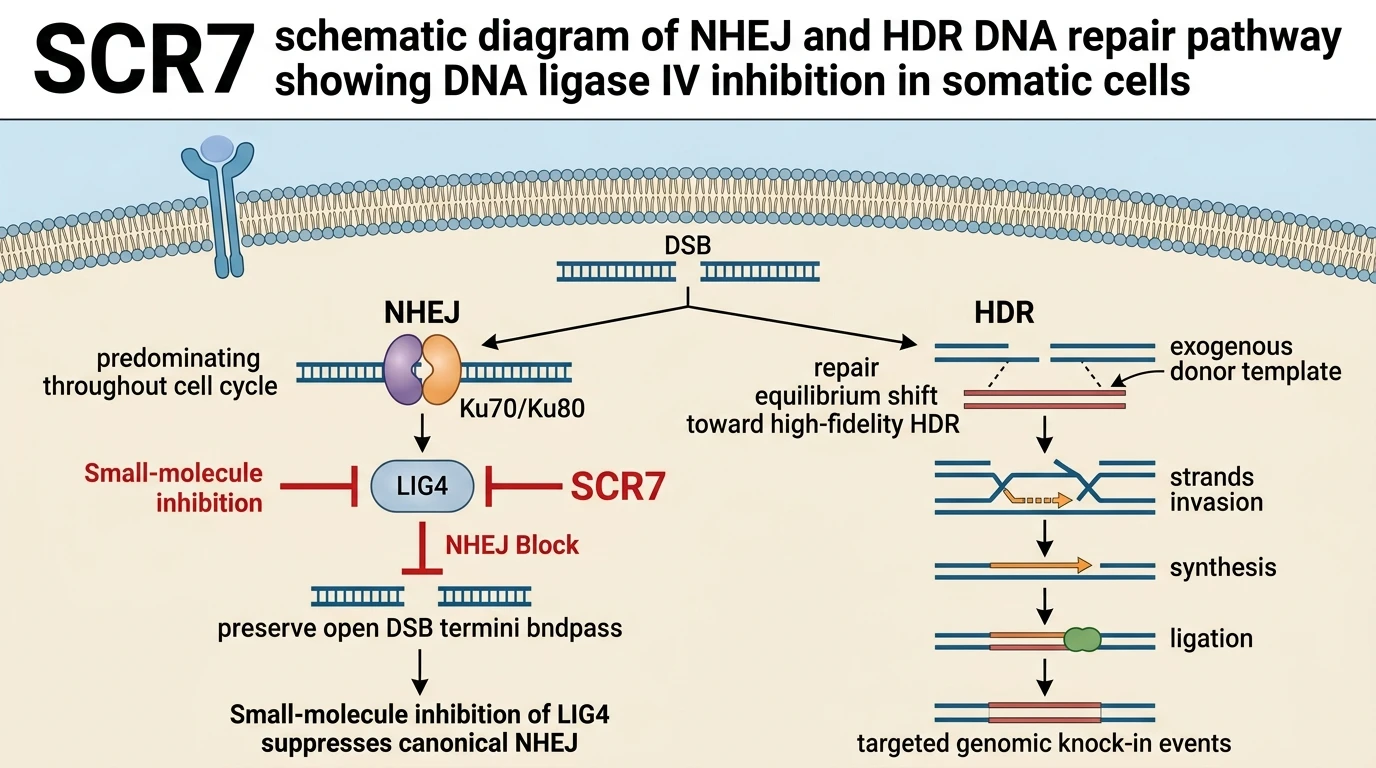
SCR7 selectively inhibits DNA ligase IV (LIG4), the critical ligase component of the non-homologous end joining (NHEJ) repair complex. By preventing LIG4-mediated direct DNA end ligation at CRISPR-induced double-strand breaks, SCR7 prolongs the presence of unjoined DNA ends. This suppression of competitive NHEJ activity shifts cellular repair kinetics toward homology-directed repair (HDR), significantly increasing precise gene integration efficiency when donor template DNA is present.
LIG4 Inhibition Doubles eGFP Reporter HDR Conversion Rates
DNA ligase IV attenuation alters double-strand break resolution. In porcine fetal fibroblasts carrying eGFP reporter constructs, supplementation with SCR7 from Selleck doubled the frequency of targeted homology-directed repair events. Cell viability remained essentially unaltered throughout treatment. Flow cytometric quantification confirmed elevated fluorescence intensity, reflecting successful gene correction without inducing severe cytotoxic responses in primary somatic cells. Target engagement proceeded without off-target mortality.
Targeted Large Fragment Integration Exceeds 50 Percent Efficiency
Large DNA insertions present distinct bioengineering challenges. Co-delivering CRISPR/Cas9 ribonucleoproteins alongside small-molecule inhibitors yielded knock-in rates above 50 percent in screened colonies, compared to 26.1 percent in untreated control cultures. Genomic integration was verified by junction PCR. Suppression of competitive end-joining machinery by SCR7 from Selleck permitted stable insertion of multi-kilobase donor cassettes into targeted loci with high operational fidelity. Clonal expansion rates remained robust post-editing.
Transcriptional Profiling Reveals Reciprocal Repair Factor Modulation
Transcriptional dynamics reflected pathway-specific remodeling. Quantitative gene expression analysis demonstrated significant upregulation of core HDR factors, alongside concurrent downregulation of essential non-homologous end-joining enzymes. The molecular equilibrium shifted toward precise synthesis. These altered expression patterns explain the improved knock-in yields observed across multiple primary fibroblast lines under controlled small-molecule treatment regimens. Biochemical selectivity governed the observed phenotypic shift.