CX-5461 (Pidnarulex) targets G-quadruplex structures to induce synthetic lethality in HR-deficient cancers
Copy code to add this image to your page
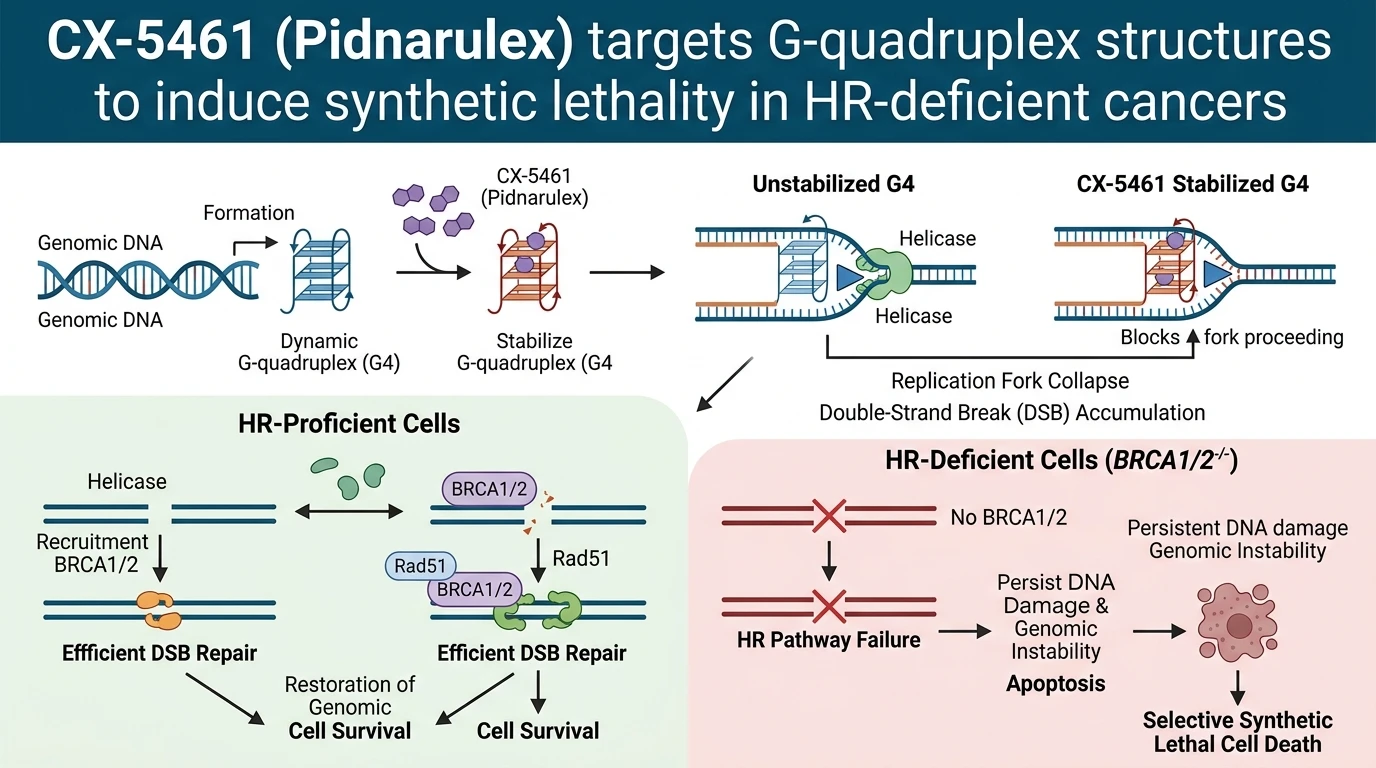
G-quadruplexes (G4s) represent secondary non-canonical nucleic acid structures that assemble within guanine-rich regions of the genome, notably within ribosomal DNA (rDNA) repeats and promoter regions of key oncogenes. These four-stranded secondary structures present physical impediments to the progression of DNA replication and transcription machinery. RNA Polymerase I specifically drives high-rate transcription of rDNA repeats within the nucleolus, producing the primary ribosomal RNA precursors required for protein translation. Small-molecule stabilization of G4 structures directly interferes with RNA Polymerase I elongation along rDNA transcripts, triggering nucleolar structure disorganization, nucleolar stress responses, and downstream cellular proliferation arrest.
CX-5461 (Pidnarulex) operates as a high-affinity small-molecule G4 stabilizer engineered to target these secondary genomic structures. Upon binding to guanine tetrads, CX-5461 (Pidnarulex) markedly increases the thermal melting temperature of G4 topologies, preventing their essential unwinding by endogenous helicases such as WRN and BLM. When active replisome complexes encounter stabilized G4 structures during S-phase progression, physical blockade occurs. This target engagement causes immediate replication fork stalling. Sustained arrest of replication machinery results in the uncoupling of DNA polymerase from helicase movement, exposing extensive single-stranded DNA (ssDNA) regions.
The unmitigated exposure of ssDNA gaps recruits endogenous structure-specific endonucleases, which cleave stalled replication forks and convert them into toxic double-strand breaks (DSBs). These structural DNA lesions are characterized biochemically by rapid phosphorylation of histone H2AX (forming gamma-H2AX foci) and localized recruitment of p53-binding protein 1 (53BP1). Cell survival following exposure to CX-5461 (Pidnarulex) depends critically upon the operational capacity of DNA double-strand break repair networks. Primary resolution of these specific drug-induced DSBs requires homologous recombination (HR), a high-fidelity repair pathway orchestrated by functional BRCA1, BRCA2, and RAD51 proteins. HR machinery recognizes the damaged fork, promotes strand invasion into homologous sister chromatids, and reinstates replication fork integrity.
In tandem with HR, non-homologous end joining (NHEJ) participates in attempting to process CX-5461-induced structural damage. Key NHEJ factors, including the catalytic subunit of DNA-dependent protein kinase (DNA-PKcs) and DNA ligase IV (LIG4), mediate end-joining mechanisms when HR pathways are overwhelmed or inactive. However, NHEJ processing at collapsed replication forks frequently generates aberrant chromosomal translocations and complex genomic rearrangements rather than conservative repair, rendering it an imperfect backup mechanism in S-phase cells.
The absolute requirement of intact HR mechanisms for resolving G4-mediated replication lesions creates a mechanistically defined vulnerability in homologous recombination-deficient (HRD) tumors. Cancer cells harboring loss-of-function mutations in BRCA1 or BRCA2, or epigenetic silencing of key HR factors, lack the enzymatic capacity to repair replication-associated DSBs. Upon exposure to CX-5461 (Pidnarulex), HR-deficient cells exhibit persistent DSB accumulation, widespread chromosomal fragmentation, and prompt activation of intrinsic apoptotic cascades. This synthetic lethal interaction allows selective destruction of HR-impaired cancer cells while sparing repair-proficient wild-type tissues.
Experimental evaluations across patient-derived xenograft (PDX) murine models substantiate these mechanistic insights in vivo. In BRCA1- and BRCA2-mutated breast, ovarian, and pancreatic tumor xenografts, treatment with CX-5461 (Pidnarulex) yields robust tumor growth inhibition and sustained regression. Conversely, HR-proficient controls demonstrate transient cell cycle delay followed by effective DNA repair and continued proliferation. These empirical observations establish the requirement of HR functional status as a predictive biomarker, defining clear entry points for G4 stabilization therapy.
Pharmacological Evaluation and DNA Repair Pathway Dynamics
Copy code to add this image to your page
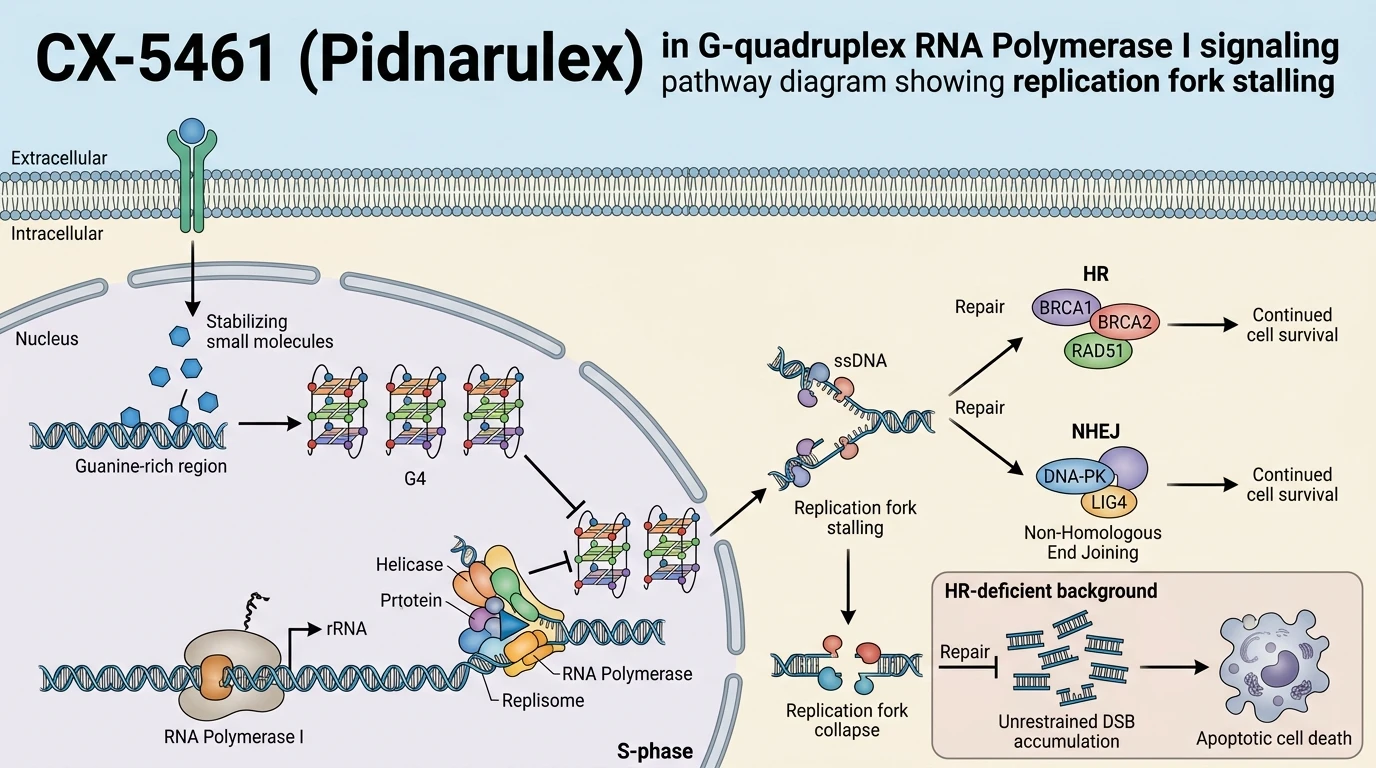
CX-5461 (Pidnarulex) acts as a small-molecule stabilizer of G-quadruplex (G4) DNA structures, disrupting transcription mediated by RNA Polymerase I. Small-molecule binding prevents helical unwinding during S-phase, resulting in replication fork stalling, single-stranded DNA gaps, and lethal double-strand breaks (DSBs). Efficient repair of these lesions depends on functional homologous recombination (HR) involving BRCA1/2 and RAD51, alongside non-homologous end joining (NHEJ) via DNA-PK and LIG4. Consequently, HR-deficient tumor models exhibit marked sensitivity, validating G4 stabilization as a targeted synthetic lethal approach.
Replication Fork Collapse and Double-Strand Break Induction
Targeting quadruplex DNA alters normal replisome progression. CX-5461 (Pidnarulex) binds higher-order G4 structures with high thermodynamic affinity. This binding event physically blocks helicase unwinding during S-phase transit. Consequently, replication forks stall rapidly upon contact with persistent G4 motifs. Prolonged fork arrest generates extensive single-stranded DNA gaps. These exposed gaps undergo enzymatic cleavage, converting transient stalls into toxic double-strand breaks—a process validated across multiple human carcinoma lines under physiologically relevant concentrations.
Homologous Recombination Mediates Survival in Repair-Competent Models
Damage resolution dictates cellular fate following G4 stabilization. Cellular recovery from drug-induced lesions requires active homologous recombination. Functional BRCA1 and BRCA2 assemble RAD51 nucleoprotein filaments at broken fork sites. In parallel, non-homologous end joining machinery—specifically DNA-PK catalytic subunits and LIG4—engages secondary repair sites. In homologous recombination-deficient patient-derived xenograft models, this repair capacity collapses entirely. Persistent double-strand breaks accumulate unchecked throughout successive cell cycles. Apoptotic cascade markers escalate rapidly in BRCA-mutated cohorts.