Leucovorin Calcium Pentahydrate (Folinic acid) in Fluorouracil Modulation and Colorectal Maintenance Therapy
Copy code to add this image to your page
Thymidylate synthase (TS) serves as a rate-limiting catalytic enzyme in de novo pyrimidine nucleotide biosynthesis, converting deoxyuridine monophosphate (dUMP) to deoxythymidine monophosphate (dTMP). Inhibition of this enzyme depletes thymidine nucleotide pools, disrupting genomic integrity and halting mitotic progression in dividing cancer cells. Fluoropyrimidines such as 5-fluorouracil (5-FU) exploit this target; however, single-agent efficacy remains constrained by the reversible binding dynamics of its active metabolite, 5-fluorodeoxyuridine monophosphate (FdUMP). modulation of folate pathways in oncology demonstrates that sustained target inhibition requires an endogenous or exogenous reduced folate co-factor to secure the enzyme-inhibitor complex.
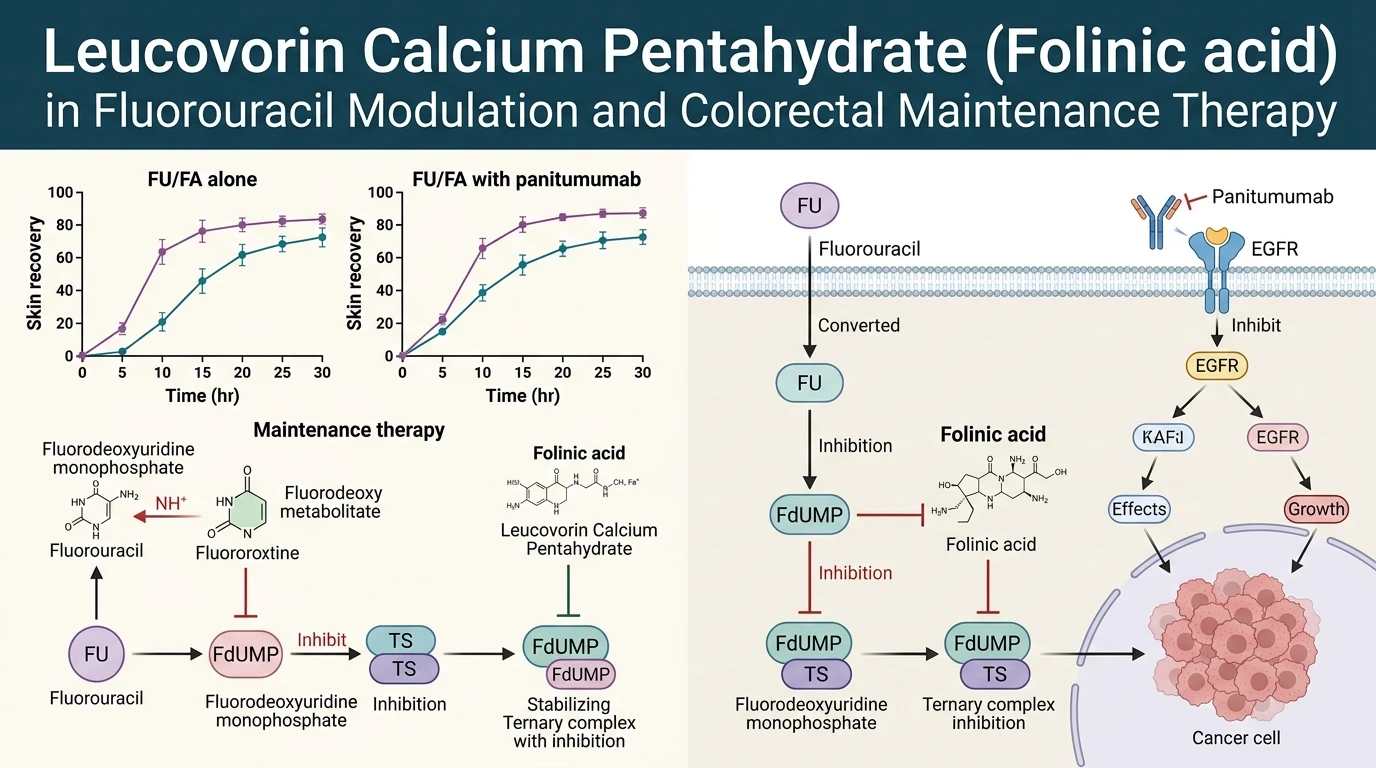
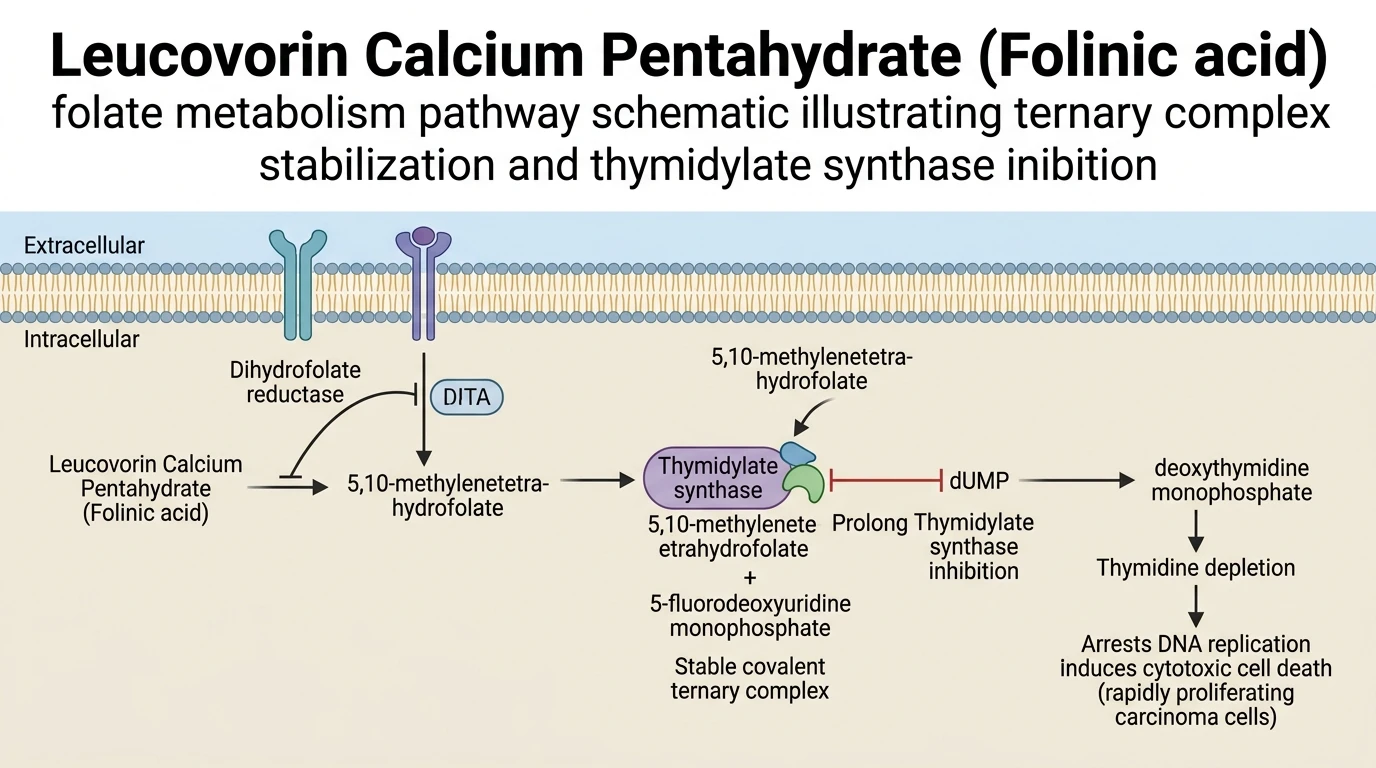
Leucovorin Calcium Pentahydrate (Folinic acid) functions as a biochemical modulator designed to overcome this kinetic limitation. Following systemic transport into malignant cells, it bypasses dihydrofolate reductase and undergoes enzymatic conversion into 5,10-methylenetetrahydrofolate (CH2FH4). This reduced folate metabolite directly participates in forming an inactive covalent ternary complex comprising TS, FdUMP, and CH2FH4. Formation of this steady-state complex locks thymidylate synthase in a non-functional state, markedly prolonging the intracellular half-life of target suppression and driving down downstream dTTP availability.
In clinical oncology, fluorouracil and folinic acid (FU/FA) combinations represent a foundational backbone for maintenance regimens in metastatic colorectal cancer (mCRC). In the phase II PanaMa trial, researchers conducted a prespecified secondary analysis evaluating patient-reported dermatology-related quality of life (DRQOL) in individuals with RAS wild-type mCRC. Patients initially completed induction chemotherapy with FOLFOX plus panitumumab (Pmab), a monoclonal antibody directed against the epidermal growth factor receptor (EGFR). Following induction, trial participants were randomized to maintenance therapy receiving either FU/FA alone or FU/FA in combination with Pmab.
Investigator-assessed dermatologic toxicities recorded during the initial induction phase strongly mirrored patient-reported DRQOL deterioration. Skin toxicities associated with EGFR blockade—including papulopustular eruption, paronychia, and xerosis—exerted a heavy burden on functional capacity and psychological well-being. Validated patient-reported outcome (PRO) instruments, specifically Skindex-16, the Dermatology Life Quality Index (DLQI), and the Functional Assessment of Cancer Therapy-EGFRI (FACT-EGFRI), successfully captured this symptom cluster. These clinical metrics confirmed that patient-reported outcomes faithfully reflect investigator-scored skin toxicities, validating PRO tools as robust scientific endpoints in maintenance trial designs.
Clinical Maintenance Dynamics and Patient-Reported Dermatologic Outcomes
Copy code to add this image to your page
Leucovorin Calcium Pentahydrate enhances 5-fluorouracil efficacy through intracellular conversion to 5,10-methylenetetrahydrofolate. This cofactor binds thymidylate synthase alongside fluorodeoxyuridine monophosphate, locking the enzyme in an inactive ternary complex. Prolonged enzyme inhibition halts dTMP synthesis, arresting DNA replication. In RAS wild-type metastatic colorectal cancer maintenance regimens, fluorouracil and folinic acid (FU/FA) sustain disease control while mitigating severe systemic toxicities observed during full induction therapy.
Patient-Reported Recovery Profiles During FU/FA Maintenance Phase
Transitioning from intensive induction chemotherapy to maintenance therapy significantly alleviated overall treatment burden. All patient cohorts demonstrated marked recovery in DRQOL scores relative to post-induction baselines. Systemic toxicity abated following oxaliplatin withdrawal. However, distinct symptom profiles emerged between treatment arms. Patients receiving cytotoxic maintenance with Leucovorin Calcium Pentahydrate and fluorouracil alone experienced rapid, sustained normalization of skin integrity. In contrast, those assigned to continuous panitumumab experienced persistent dermatologic secondary effects. These empirical metrics highlight the favorable tolerability profile of isolated fluoropyrimidine-folate maintenance regimens.
Anti-EGFR Toxicity Differentiation Across Patient Quality-of-Life Measures
Quantifiable differences between maintenance arms achieved statistical significance across multiple instrument subscales. At treatment cycle six, the addition of panitumumab to FU/FA maintained elevated DRQOL impairment scores. A mean difference of 16.53 points was recorded on the Skindex-16 scale (P < 0.001), indicating substantial physical and emotional distress in the anti-EGFR arm. Similar comparative trends persisted across DLQI and FACT-EGFRI evaluations. The control arm receiving FU/FA alone demonstrated minimal ongoing cutaneous pathology. These data confirm that skin-targeted PRO instruments reliably track ongoing treatment burden during low-intensity maintenance phases.