Vorasidenib (AG-881) dual IDH1/2 inhibition restores glutamate flux in glioma
Copy code to add this image to your page
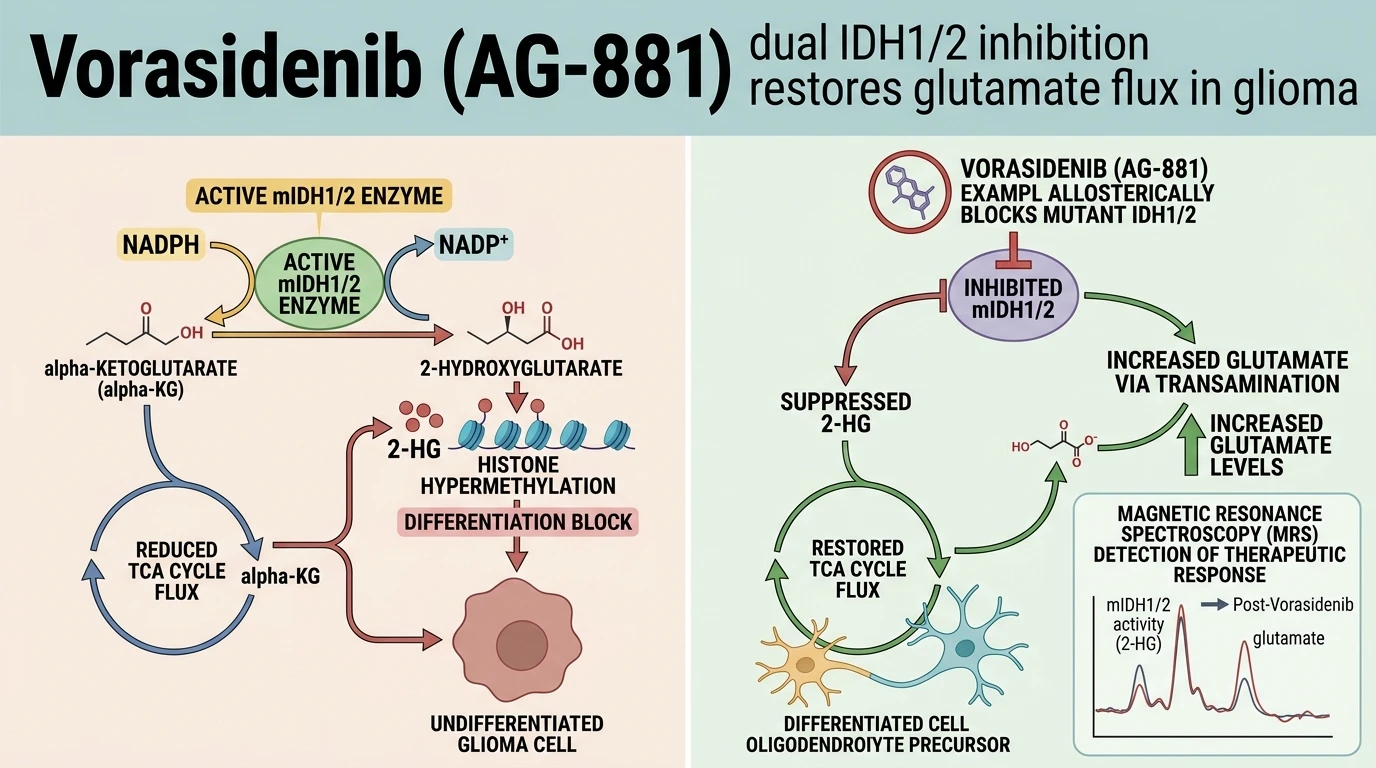
Somatic heterozygous mutations in isocitrate dehydrogenase 1 (IDH1, localized to the cytoplasm and peroxisomes) and isocitrate dehydrogenase 2 (IDH2, localized to the mitochondria) represent early, defining genetic alterations in lower-grade gliomas and secondary glioblastomas. In wild-type enzymes, IDH catalyzes the reversible oxidative decarboxylation of isocitrate to alpha-ketoglutarate (a-KG), generating NADPH. Point mutations occurring at key active site arginine residues—most prominently IDH1-R132, IDH2-R140, and IDH2-R172—alter catalytic properties. Rather than performing standard decarboxylation, mutant IDH1 and IDH2 acquire neomorphic enzymatic activity that consumes NADPH to reduce a-KG into the oncometabolite D-2-hydroxyglutarate (2-HG). Structural biology demonstrates that these mutations trap the enzyme in a distinct active conformation, facilitating high-affinity 2-HG production.
The intracellular accumulation of 2-HG reaching millimolar levels profoundly disrupts cellular homeostasis. Because 2-HG shares structural similarity with a-KG, it acts as a competitive antagonist against a-KG-dependent dioxygenases. Key targets include the Ten-Eleven Translocation (TET) family of 5-methylcytosine hydroxylases and Jumonji C (JmjC) domain-containing histone demethylases. Inhibition of TET enzymes results in global DNA hypermethylation, establishing the Glioma CpG Island Methylator Phenotype (G-CIMP). Concurrently, histone demethylase blockade elevates repressive histone marks, such as H3K9me3 and H3K27me3. This concerted epigenetic remodeling prevents neural progenitor differentiation, locking cells in a self-renewing, undifferentiated state that drives tumor progression. Furthermore, 2-HG reshapes cellular energy infrastructure by altering electron transport chain activity and disrupting tricarboxylic acid (TCA) cycle intermediate pools.
Vorasidenib (AG-881) was engineered as a brain-penetrant, orally bioavailable dual inhibitor targeting both mutant IDH1 and IDH2 homodimers and heterodimers. Unlike first-generation single-isoform inhibitors, Vorasidenib penetrates the blood-brain barrier effectively, yielding uniform target coverage across intracranial brain tumor tissue. Pharmacological evaluation in patient-derived IDH1-mutant low-grade glioma models demonstrates potent target engagement. Treatment with Vorasidenib (AG-881) produces a pronounced drop in intracellular 2-HG concentrations within hours of exposure under controlled in vitro culture conditions. Interestingly, this acute metabolic inhibition does not immediately alter total cell numbers or trigger rapid cytotoxic cell death. Instead, long-term self-renewal assays reveal a reduction in clonogenic capacity, confirming that therapeutic efficacy relies on differentiation induction and metabolic normalization rather than immediate necrosis.
To map these biochemical dynamics, multinuclear magnetic resonance spectroscopy (MRS)—spanning proton (1H-MRS), carbon-13 (13C-MRS), and hyperpolarized 13C-MRS—provides dynamic metabolite tracking. Across tested glioma models, 2-HG depletion is consistently accompanied by a statistically significant increase in steady-state glutamate levels. Metabolic flux analysis using 13C-labeled precursors demonstrates that blocking mutant IDH activity redirects a-KG flux away from 2-HG reduction and back into classical transamination pathways, enhancing the conversion of glutamine to glutamate. Real-time imaging using hyperpolarized [1-13C] a-KG MRS captures both decreased 2-HG labeling and accelerated glutamate resynthesis within minutes of administration. These metabolic metrics establish non-invasive imaging signatures for tracking early pharmacodynamic response during mutant IDH inhibition in neuro-oncology.
Metabolic Profiling and Non-Invasive Biomarker Validation
Copy code to add this image to your page
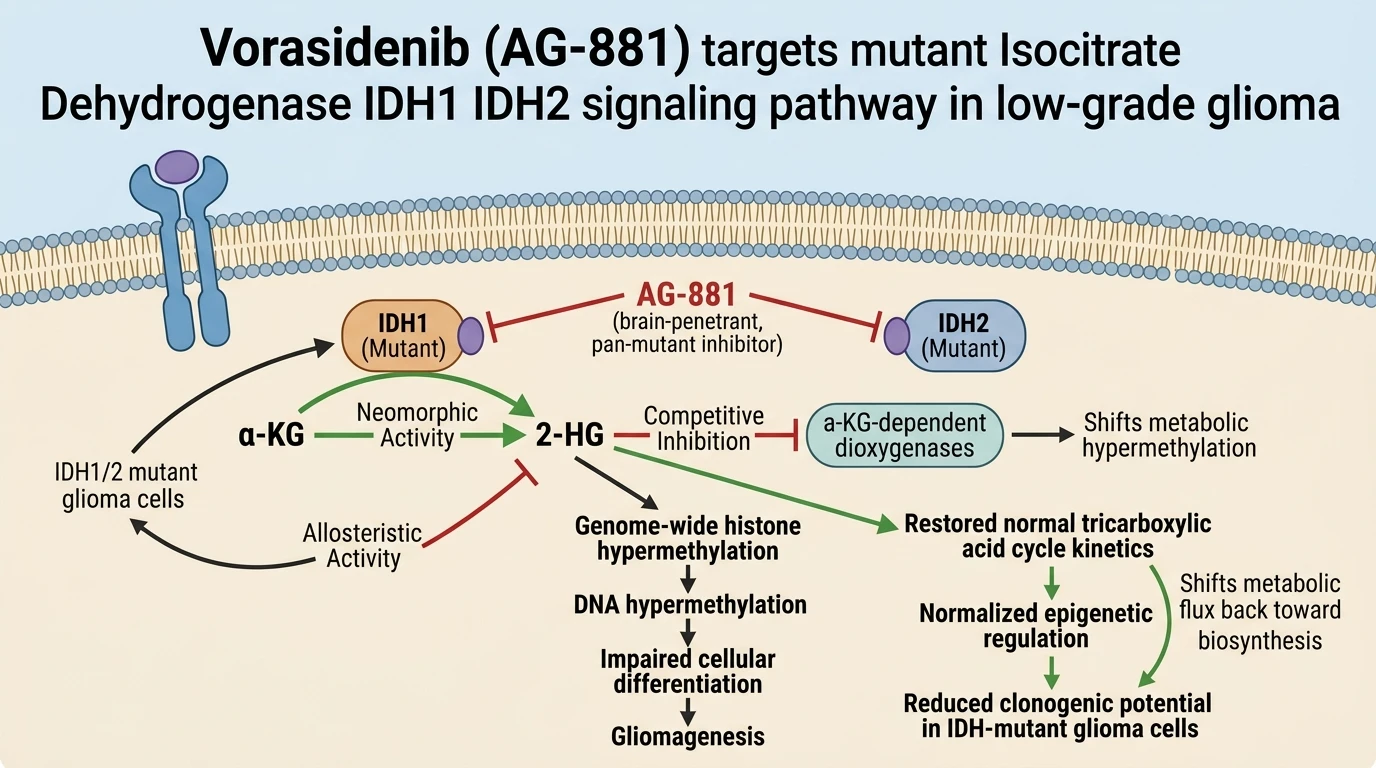
Vorasidenib (AG-881) is a brain-penetrant allosteric dual inhibitor of mutant IDH1 and IDH2 enzymes. By blocking the neomorphic NADPH-dependent reduction of alpha-ketoglutarate to D-2-hydroxyglutarate (2-HG), it depletes intracellular 2-HG pools. This enzymatic inhibition reverses metabolic reprogramming, normalizing tricarboxylic acid cycle kinetics and increasing conversion of glutamine to glutamate. Consequently, Vorasidenib restores differentiation pathways and reduces clonogenic survival in IDH-mutant glioma cells.
Suppression of Oncometabolite 2-HG and Clonogenic Survival
Target engagement was quantified in patient-derived glioma cell models harboring IDH1 mutations. AG881 administration led to a prompt reduction in intracellular 2-HG concentrations. Total cell viability remained largely unchanged during early exposure. The compound exerted a cytostatic rather than acutely cytotoxic effect under tested culture conditions. However, long-term clonogenic assays revealed a marked impairment in self-renewal capacity. Colony formation dropped significantly across all treated groups—confirming that metabolic normalization dampens stem-like tumorigenic potential.
Hyperpolarized 13C-MRS Tracks Real-Time Glutamate Resynthesis
Multinuclear magnetic resonance spectroscopy provided direct insight into metabolic flux changes. Stable isotope tracing with 13C-labeled precursors demonstrated increased glutamine-to-glutamate conversion following AG881 exposure. This metabolic pivot restores physiological tricarboxylic acid cycle dynamics; a-KG is directed toward amino acid transamination rather than oncometabolite synthesis. Real-time tracking using hyperpolarized [1-13C] a-KG MRS confirmed this enzymatic shift. Spectroscopic signals recorded a rapid decrease in 2-HG production alongside elevated glutamate synthesis. Consequently, non-invasive MRS imaging establishes a dynamic pharmacodynamic signature for monitoring early therapeutic response in vivo.